
More on Coping
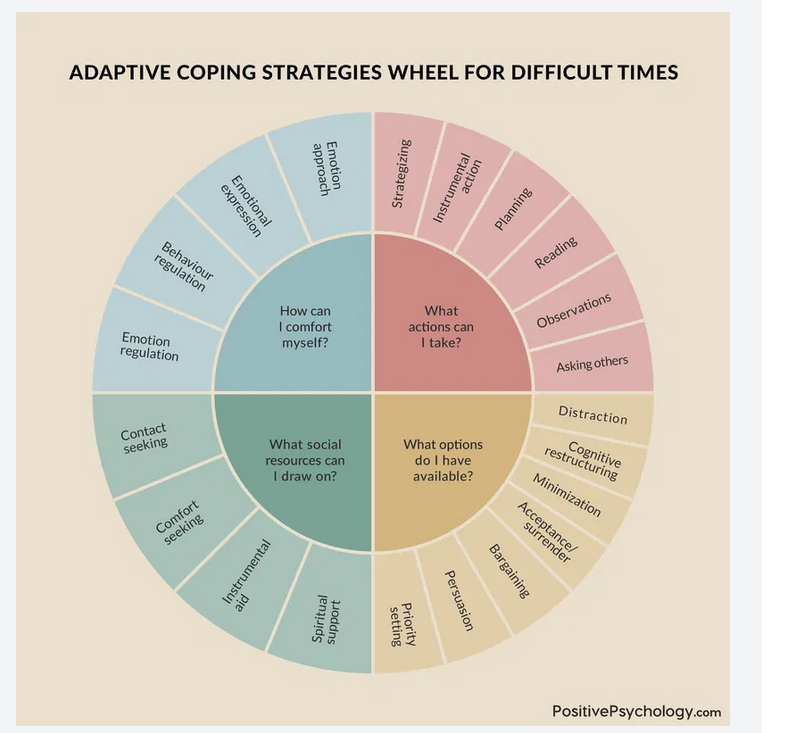
(source: Tiffany Sauber Millacci, 2017)
A description of strategies to handle each of the 4 central guiding questions:
- How can I comfort myself? (Blue quadrant)
These strategies focus on self-regulation and emotional relief:
- Emotion regulation (managing emotional reactions in healthy ways.)
- Behaviour regulation (adjusting actions to improve mood or cope better.)
- Emotional expression (letting emotions out through writing, talking, or art.)
- Emotion approach (facing emotions with curiosity and acceptance.)
- What actions can I take? (Red quadrant)
These strategies help in solving problems and taking control:
- Strategizing (developing a plan to address the challenge.)
- Instrumental action (taking direct steps to resolve the issue.)
- Planning (organizing tasks or steps for clarity and direction.)
- Reading (gaining knowledge or distraction through reading.)
- Observations (noticing patterns or learning from what’s happening.)
- Asking others (seeking input, advice, or clarification.)
- What social resources can I draw on? (Green quadrant)
These emphasize reaching out for help or support:
- Contact seeking (reaching out to connect with others.)
- Comfort seeking (looking for emotional reassurance and warmth.)
- Instrumental aid (asking for practical help or assistance.)
- Spiritual support (drawing strength from spiritual beliefs or communities.)
$. What options do I have available? (Yellow quadrant)
These focus on reframing or adapting to the situation:
- Priority setting (deciding what’s most important to focus on.)
- Persuasion (convincing oneself or others to adopt a helpful mindset.)
- Bargaining (attempting to make deals to ease the situation.)
- Acceptance/surrender (letting go of control where necessary.)
- Minimization (downplaying the impact to reduce emotional distress.)
- Cognitive restructuring (changing unhelpful thought patterns.)
- Distraction (diverting attention to reduce emotional pain temporarily.)