
Framework 134 Change Practice Framework
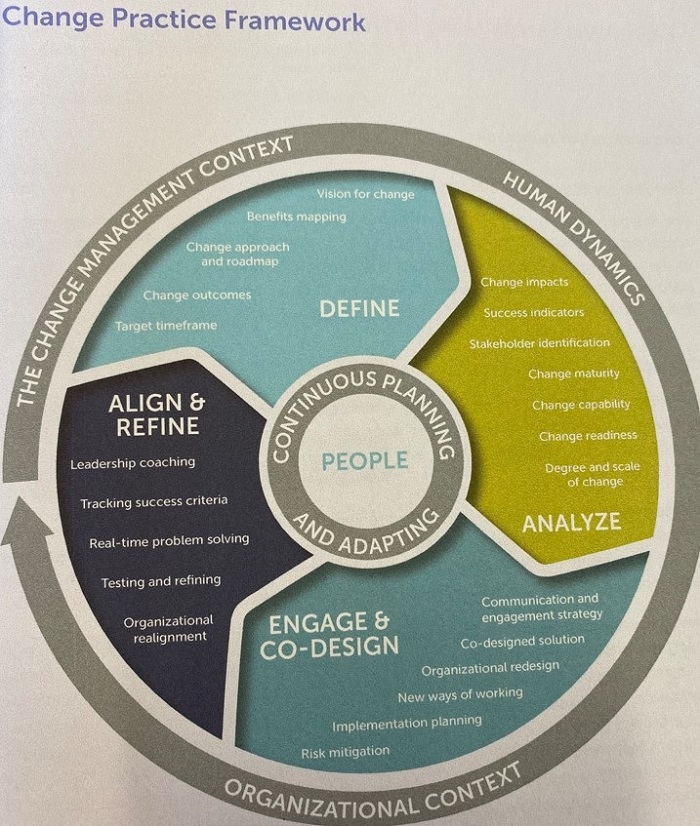
(source: CMI, 2022a)
"...at the centre of all change is people......change managers are continuously adapting and planning their activities throughout the change life-cycle and there is a focus on different practical dimensions and associated outputs. These practice dimensions are represented as define, analyse, co-design, and aligne & refine..."
CMI, 2022a
Components and dimensions in the above diagram
i) define
- vision for change
- benefits mapping
- change approach and roadmap
- changing outcomes
- target timeframe
ii) analyse
- change impacts
- success indicators
- stakeholder identification
- change maturity
- change capability
- degree and scale of change
iii) engage and co-design
- communications and engagement strategy
- co-designed solution
- organisational redesign
- new ways of working
- implementation planning
- risk mitigation
iv) align and refine
- leadership coaching
- tracking success criteria
- real-time problem-solving
- testing and refining
- organisational realignment
(source: CMI, 2022a)
NB As change is not linear, the execution, activities, outputs, etc need to be continuously revisited; underpinning all are 3 applied knowledge areas: change management context, organisational context and human dynamics
More details on the components and dimensions:
Consider these components: Define, Analyse, Engage & Co-design, Align & Refine.
- What does each mean?
- What kinds of activities or outputs typically belong in each component?
- How do they relate to each other?
NB This framework treats change management not as a linear sequence, but as a cycle; the 4 “practice dimensions” (Define, Analyse, Engage & Co-design, and Align & Refine) are areas of activity that are revisited continually throughout a change initiative.
Underpinning all of these are 3 applied knowledge areas:
- Change management context (what is driving the change, internal/external environment, etc)
- Organisational context (structure, culture, capacity, etc)
- Human dynamics (how people are affected, behaviour, mindset, resistance etc.)
The Four Practice Dimensions (with typical outputs and activities):
|
Dimension |
Key Purpose / Questions Addressed |
Typical Activities / Outputs |
|
Define |
Establish what the change is, why it’s needed, what success will look like; set direction. What is the vision? What are the outcomes? Over what timeframe? What benefits are sought? What kind of change approach will be used? |
• Vision statement for the change
|
|
Analyse |
Understand the context deeply: What will be impacted? How ready is the organisation? Who needs to be involved? How big/complex is the change? What metrics will tell us if we’re succeeding? |
• Change impact assessment (on processes, roles, people, systems, etc) |
|
Engage & Co-design |
Co-create the change with stakeholders; plan implementation; redesign processes/structures/ways of working; mitigate risks; build buy-in and ownership. It’s about making sure that the solution is workable, that people are part of shaping it, and not just being told what will happen. |
• Communication & engagement strategy (how to communicate, with whom, when)
|
|
Align & Refine |
Ensure the change is embedded, continually improved, aligned with leadership and strategy, and adapted as real-world feedback comes in. Manage the change in during implementation (not just plan). |
• Leadership coaching (so leaders model, support, sustain) |
Relationships & Iteration
- These dimensions are not sequential phases in a rigid sense; rather, they are revisited throughout the life of the change initiative. For example, you might define a vision, analyse stakeholder impacts, engage people, refine the solution; but then, as something unexpected surfaces, you may need to go back to “define” or “analyse” in light of new information.
- Leadership commitment matters throughout, especially under “align & refine”, but also during define/engage.
- Feedback loops are essential: refine based on what’s working/what’s not; engage regularly to gauge sentiment; analyse periodically to check readiness etc.