
Common Change Management Error (3 cont. i)
How to Detox an Organisational Culture
Introduction
Estimates exist that about 10% of US workers view their works place culture as toxic (Donald Sull et al, 2022a).
The first step is to acknowledge that pockets of toxicity exist, even in the healthiest corporate cultures. There can be micro-cultures within the organisation that can be toxic.
Furthermore, measuring corporate culture by averages and aggregates can, usually inadvertently, obscure pockets of toxicity.
Research has identified 5 attributes/behaviours that contribute to a toxic culture from staff's point of view, ie
i) disrespectful
ii) non-inclusive
iii) unethical
iv) cut-throat
v) abusive
(for more details, see elsewhere in the Knowledge Base)
Some steps for transforming toxic cultures include:
i) investing in career and personal development
ii) encouraging social activities to build a sense of community (like informal gatherings, sporting and cultural events, community-based activities, etc)
iii) encouraging flexibility and autonomy (allow people to make their own decisions around both work and non-work situations)
iv) providing predictable schedules (it is
"...6 times more powerful predicting of front-line staff retention than a flexible schedule..."
Donald Sull as quoted by John Horn, 2022
White-collar workers generally want more flexibility, like remote working options.
The most critical drivers to fix a toxic culture are leadership, social norms and workplace design
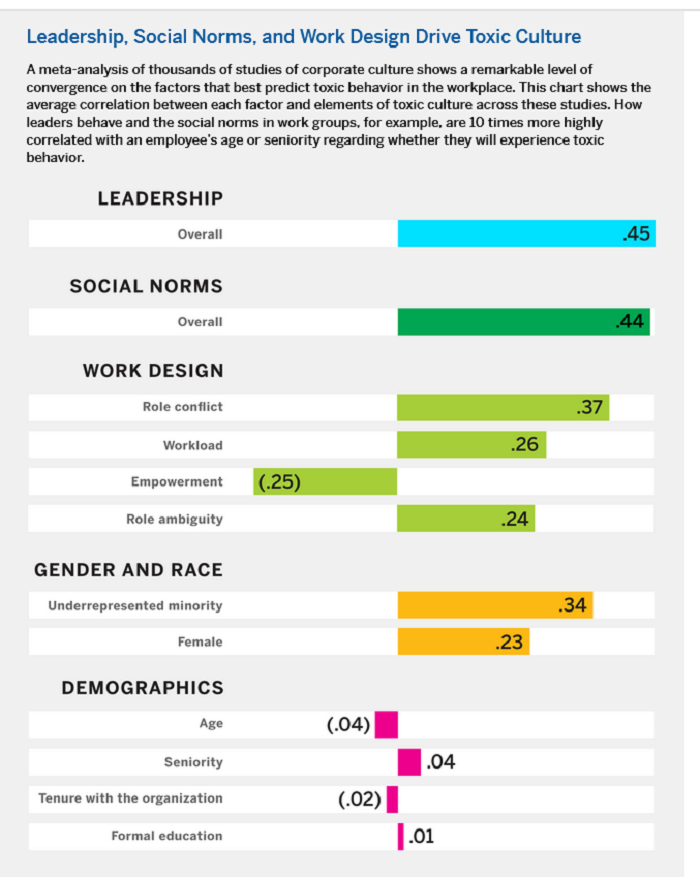
(source: Donald Sull et al, 2022a)
Most senior executives believe that improving the the health of their corporate culture would boost performance. However, lack of leadership was the dominant obstacle to closing the gap between cultural aspirations and current reality. Yet most executives don't know where to start on cultural improvement, ie
"...What specific aspects of corporate culture should they focus on fixing? What concrete actions can they take? And how can they measure progress over time?
Donald Sull et al, 2022a
"...There is no one-size-fits-all approach to fixing a toxic culture..."
Donald Sull et al, 2022a
Employees can respond to a toxic workplace by the following:
- exit (bbecoming disengaged from their work or quitting the organisation)
- voice (lodging complaints with management or posting negative online reviews)
- loyalty (staying with the organisation despite the toxicity)
However, there are some general principles to follow.