(Nudging As Part Of Behavioural Economics Cont. 6)
Nudging
Introduction
The basis of nudge theory is understanding how people assess choices and make decisions; this involves
"...- Understanding how people think, make decisions, and behave,
- Helping people improve their thinking and decisions
- Managing change of all sorts, and
- Identifying and modifying existing unhelpful influences on people..."
Businessballs, 2023
Most of our thinking and decision-making are instinctive and irrational, rather than logical and rational; we have many different irrational human tendencies/considerations or 'fallibilities' or 'heuristics' or 'weaknesses' or 'bad habits', etc which can influence our thinking, behaviours and decision-making.
Factors that can influence decision making include inertia, optimism, denial, lethargy, the inability to delay gratification, false assumptions, etc.
Nudge theory is mainly concerned with design of choices which influences decisions you make. It was initially developed to encourage people to make better decisions for improving the community. However, its potential has been realised elsewhere.
Nudge theory is very relevant to leadership, motivation, change management (when needing to minimise resistance, confrontation, etc), personal/self-development, etc; it is linked with systems 1 & 2 thinking, motivation theories like Maslow, McGregor, etc, psychological contract, neuro-linguistic programming, ethical business and management, etc. Some governments, including those of the UK and USA, have formed special departments to utilise nudging techniques to shift societal behaviours.
(for more details, see elsewhere in the Knowledge Base)
"...Nudge principles and techniques are now increasingly significant in communications, marketing and motivation groups: in business, marketing, selling, organisational leadership, politics, economics, education, welfare; really, in any situation where someone......seeks to influence a person or a group of people......through indirect methods...... by offering choices..."
Businessballs, 2023
Nudge theory accepts that people have certain attitudes, knowledge, capabilities, beliefs etc and these can impact your thinking and decision making:
"...Nudge theory is based on understanding and allowing for the reality of the situation and human tendencies (unlike traditional forcible instruction, which often ignore or discounts the reality of situations and people)...seeks to minimise resistance and confrontation, which commonly arises from more forceful 'directing'and autocratic methods of changing people/behaviour......can also be used to identify, explain, and modify existing heuristic effects on people and society groupings - especially when these efforts are unhelpful or damaging to people/society......has dramatically affected thinking and methods of motivating and changing people..... ..."
Businessballs, 2023
Nudging is most successful when people have positive feelings like trust, credibility, etc towards whomever the nudger is and/or whatever is being nudged. For example, this can be the basis of building brand awareness, ie the basis of building a perceived sense of trust and reliability.
Some examples of the traditional approach compared with nudging (with definitionss):
| Traditional enforced change |
Nudge techniques |
| Definition | |
| 'Forcing' method is drastically direct & requires conscious, determined effort (by the person/people wanting the change) Forcing methods are confrontational and liable to provide resistance |
Nudge methods are easier for people to imagine doing, & less threatening and disruptive to actually do Nudge methods are indirect, tactical and less confrontational; can be co-operative and pleasurable |
| Examples | |
| 1. Specific | |
| Instructing a small child to tidy his/her room | Playing a 'room-tidying' game with a child |
| Joining a gym | Using the stairs |
| Weekly shop budgeting | Using a basket instead of a trolley |
| 2. General | |
| Direct, obvious | Indirect, subtle |
| Legislation, rules, regulations, laws, procedures | Enablement, facilitation |
| Enforcement, policing | Helpful assistance |
| Judgmental | Non-judgemental |
| Spin, slant, emphasis | Translation, interpretation |
| Sell, negotiate, push, pull | Offer, wait, give space |
| Deadlines | Open-ended |
| Bias | Neutrality |
| Instruction, direction | Education, information |
| Control of information | Enable understanding |
| Persuasion, cajolement | Example, evidence |
| Encouragement | Referencing peer activity |
| Non-compliance penalties | Self-discovery, heuristics |
| Dichotomous options | Unlimited options |
| Pressure | No pressure |
| Imposed action | Option of zero action |
| Enforced choices, imposed | Free choices |
| Justification, argument | Referencing social norms |
| Selective truth | Openness, nothing withheld |
| Talk down to | Discuss with |
(source: Businessballs, 2023)
Nudging is more about using indirect methods of persuasion and motivation to make better decisions for both individuals and groups.
Summary
Nudge theory is extremely adaptable, extendable and relatable; it is different from the more traditional approaches:
"...Conventional methods of changing people use direction and enforcement, often with the threat of punishment, whereas Nudge theory entails changing people's environment and choices so they are more likely to make decisions that are helpful and positive (for themselves)..."
(source: Businessballs, 2023)
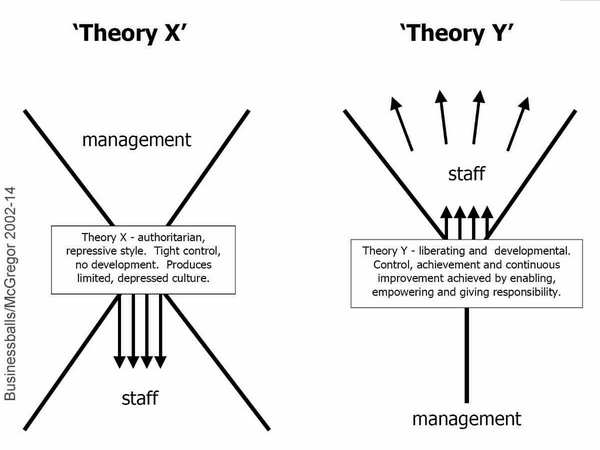
An alternative way of explaining it is to use theory X (traditional) and theory Y (nudge); nudging is about enabling rather than enforcing: