
Leadership is a Conversation
Introduction
With changes in technology and the pandemic (starting 2020) encouraging remote working, the traditional command-and-control management approach is under threat.
This will change the way leaders communicate within their organisations, ie how to handle the flow of information to, from, among their staff. It will encourage a more conversational approach, ie more person-to-person conversation rather than commands from above.
Four key elements of organisational conversation (4 Is)
i) intimacy, ie getting close (minimise distances, ie mainly institutionally, conversational and attitudinal and less spatially, ie
"...Physical proximity between leaders and employees is not always feasible. Nor is it essential. But what is essential is mental or emotional proximity..."
Boris Groysberg et al, 2012
Conversational intimacy is cultivated by the art of listening and speaking with staff directly, authentically, personally and transparently. It involves an exchange of ideas and gaining trust.
"...it's less corporate in tone and more casual. And is less about issuing and taking orders than asking and answering questions..."
Boris Groysberg et al, 2012
Conversational intimacy is about
- gaining trust (it is hard to achieve and easy to lose; need to be authentic, transparent and straightforward; need to gain the respect of stakeholders, etc)
- listening well (know when to stop talking and start listening; conversational intimacy involves
"...attending to what people say. True attentiveness signals respect for people of all ranks and roles, a sense of curiosity, and even a degree of humility..."
Boris Groysberg et al, 2012
- getting personal (know people's stories, ie until you know a person's story, you don't know them; solicit feedback on your own performance, ie
"...taking the bad with the good, absorbing criticism even when it is direct and personal - and even when those delivering it work for you..."
Boris Groysberg et al, 2012
ii) interactivity (promoting dialogue, ie 2-way discussions; talk with people and not at, or to, them, ie
"...make conversations open and fluid rather than closed and directive. It involves shunning the simplicity of monologue and embracing the unpredictable vitality of dialogue..."
Boris Groysberg et al, 2012
Encourage stakeholders to 'speak out' and 'talk back', ie enable high-quality back-and-forth communication.
Discourage management from
"...the temptation to treat every medium at their disposal as if it were a megaphone..."
Boris Groysberg et al, 2012
Use all communication channels, ie print and broadcast plus social media; the last is more 2-way than the first two.
iii) inclusion (expanding staff members' roles so that they are fully-fledged conversation partners as a way to raise staff emotional engagement
"...At its best, personal conversation is an equal-opportunity endeavour. It enables participants to share ownership of the substance of their discussion......organisational conversations......call on the employees to participate in generating the content that makes a company's story..."
Boris Groysberg et al, 2012
It is linked with intimacy and interactivity.
"...Whereas intimacy involves the efforts of leaders to get closer to employees, inclusion focuses on the role that employees play in that process. It also extends the practice of interactivity by enabling employees to provide their own ideas..."
Boris Groysberg et al, 2012
Staff are front-line content providers who become brand ambassadors, thought leaders and storytellers
- brand ambassadors (living representatives of the brand, ie
"...lots of people love what they do for a living and will talk it up on their own time..."
Boris Groysberg et al, 2012)
- thought leaders (most appropriate in knowledge-based fields; encourage staff to develop, test and publicise new products and services so that they boost organisation's reputation amongst key industry players)
- storytellers (encourage front-line staff to speak publicly of their own experiences, unedited; more credible than hearing corporate communication)
NB
"...inclusion means that executives cede a fair amount of control over how the company is represented to the world..."
Boris Groysberg et al, 2012
However, technological changes around the Internet and social media have reduced this control anyway.
The free flow of information is increasing staff's engagement. Furthermore, a system of self-regulation by staff handles most outrageous statements.)
iv) intentionality (pursuing an agenda; it infers order and meaning, ie
"...The conversation that unfolds within a company should reflect a shared agenda that aligns with the company's strategic objectives..."
Boris Groysberg et al, 2012
Intentionality differs from the 3 other elements of organisational conversation as it brings a measure of closure; while intimacy, interactivity and inclusion all serve to open up the communications.
Intentionality
"... Enables leaders and employees to derive strategically relevant action from the push and pull of discussion and debate. Conversational intentionality requires leaders to convey strategic principles not just by serving them but explaining them - generating consent rather than commanding assent..."
Boris Groysberg et al, 2012
Staff are informed about the vision and the logic that underlies executive decision-making. This helps everyone gain a better understanding of the big picture and the competitive environment. This can be expanded to include staff involved in creating the strategy, ie co-creating to get buy-in and ownership by the staff of the strategy.
"...technology and social networks enable bottom-up participation..."
Boris Groysberg et al, 2012
Summary of organisational conversation (intimacy, interactivity, inclusion and intentionality)
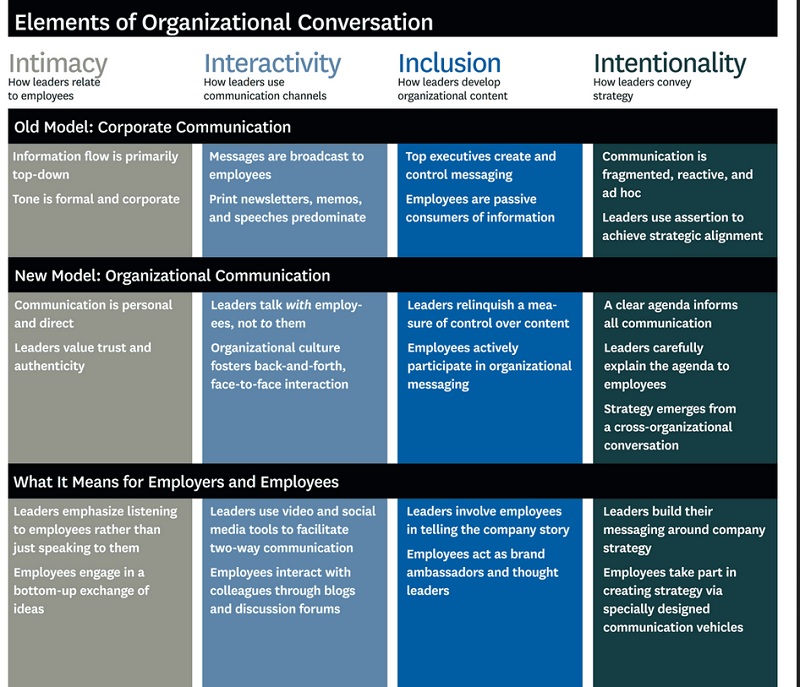
(source: https://hbr.org/resources/images/article_assets/hbr/1206/R1206D_A_LG.gif)

"...treat conversations as a means to an end - use it to achieve strategic alignment across a diverse group of participants. Conversation goes on in every company, whether you recognise it or not......today these conversation has the potential to spread well beyond your walls, and it is largely out of your control. Smart leaders find ways to use conversation - to manage the flow of information in a honest, open fashion......people will listen to communication that is intimate, interactive, inclusive and intentional..."
Boris Groysberg et al, 2012