
(Nudging As Part Of Behavioural Economics Cont. 8)
Some Examples of Nudges:
- use a similar example
"...Good way to increase people's fear of bad outcome is to remind them of related incidents in which things went wrong; a good way to increase people's confidence is to remind them of a similar situation in which everything worked out for the best..."
Richard Thaler et al as quoted by Businessballs, 2023
- brand awareness that uses multi- heuristics, ie availability (includes familiarity) plus using the conforming, spotlight & framing heuristics).
"...the concept of brand awareness is largely based on the Nudge principle called 'availability' (in terms of 'familiarity'). That is to say, we tend to trust well-known brands because they are familiar to us. The corporations which have developed such brand awareness are exploiting the 'availability' heuristic......combine this tactic with the use of 'following the herd' (conforming) heuristic and probably a few other nudges, such as the 'spotlight effect' (appealing to people's heightened sense of self being judged by others) and 'framing' (by presenting their brands/products and services offerings according to people's desires, fears, sympathies, etc)..."
Businessballs, 2023
- slow for Sam
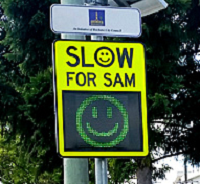
(source: BCC, 2023)
These speed awareness monitors aim to modify motorist behaviour by reducing vehicles speeding in urban areas, ie
"...if you are travelling at or below the speed limit, you will receive a smiley face from SAM. SAM displays a slowdown message if you are speeding to remind you to reduce your speed and drive safely..."
BCC, 2023
SAMs were introduced in late 2013 in Brisbane, Australia. Since then speeding motorists have reduced their speeds by an average of around 8 km/hour across all locations.
- placement of resources in the workplace, eg making recycling options more accessible than rubbish bins in communal space
- flexible working hours (designed to encourage people to arrive and leave their office at off-peak times in an effort to ease congestion on public transport and roads, eg only available for meetings between 9.30 am to 3.30 pm plus using an award system relating to commuting behaviour. This resulted in
"...Work arrivals outside of peak hours increased by 8.6 percentage points and departures by 3 percentage points..."
Chloe Hava, 2021
- positive reinforcement (performance management used to generate behavioural change, ie encourage good behaviour and discourage bad behaviour)
- default position, ie make things easier for people (eg people were allocated appointments for annual health check-ups rather than for them to choose and arrange the date themselves. This resulted in an increased from 18 to around 65% of people attending annual health check-ups.)
- Ultra-processed food (UPF)
UPF are
"...high in fat, salt and sugar: there are inherent harms to eating ingredients that have undergone complex, industrial processes and are preserved, blocks out or make palatable by artificial additives..."
Sophie McBain, 2023
Most UPFs offer an ingenious blend of irresistible flavouring and preservatives as nudges; this food is engineered to override your appetite and hoodwink your senses, ie
"...When you register the umami hit of cheese-and-onion crisps, your brains expects something rich and satisfying, not a sad mouth full of starch. Ice cream is too cold to smell, and so some manufacturers use caramel-centred wrappers to prime consumers..."
Sophie McBain, 2023
The convenience of these UPFs is an important nudge factor, ie
"...it's that eating fresh, unprocessed food requires having the time and equipment to cook, and the money and space to buy in bulk..."
Sophie McBain, 2023
- Airlines
They offer deals that use nudging, eg
i) offer deals that are available for a short amount of time at a higher price (the rational brain would most likely reject this; however, your brain will respond to scarcity)
ii) loss aversion (makes you hypersensitive to losing money and more likely to buy something, such as travel protection)
iii) decoy effect (makes you more likely to choose between 2 sub-options when a third, even worse, option is offered), eg
"...offer......an expensive premium ticket with few amenities, which may make it cheaper. A premium ticket with more benefits would look more appealing..."
Sam Kemmis, 2023
Linked with this is that budget airlines are offering rock bottom prices while charging more for basic add-ons, such as carry-on bags and seat selection:
"...skipping the extra fees means forgoing amenities that many travellers consider vital..."
Sam Kemmis, 2023
iv) social proof (to upsell certain products, such as travel protection, by suggesting many other people are doing this. However, these marketing tactics don't offer much real-world value for customers.)
vii) decision fatigue (you can easily make bad decisions when you have to make several decisions quickly, eg
"...This airline or that? Early flight or later? Pay for a window seat? Pay now for a check bag? Upgrade to premium economy? With each decision, our ability to make ideal choices diminishes..."
Sam Kemmis, 2023
To overcome decision fatigue, etc requires time and energy, ie consider booking flights when you are not rushed and have time to study the comparisons plus knowing what is important to you, eg
i) seat selection (a family travelling together would be more willing to pay for seat selection so that they can sit together than a solo traveller who would be less likely to be interested in seat selection)
ii) flight time (an earlier flight might be cheaper, but how much is a few more hours sleep worth?)
"...If you want to overcome these biases, you'll have to slow down and give yourself a space to pay attention to these things......the trick is to determine ahead of time what you really need, otherwise you could be swayed by the upsell..."
Cait Lamberton as quoted by Sam Kemmis, 2023)
NB
"...unconscious behaviours prevent us from making the best decisions..."
Sam Kemmis, 2023